
Every few months, someone declares that SEO is dead. It rarely is. But something meaningful is changing right now — and this time, business owners should pay attention.
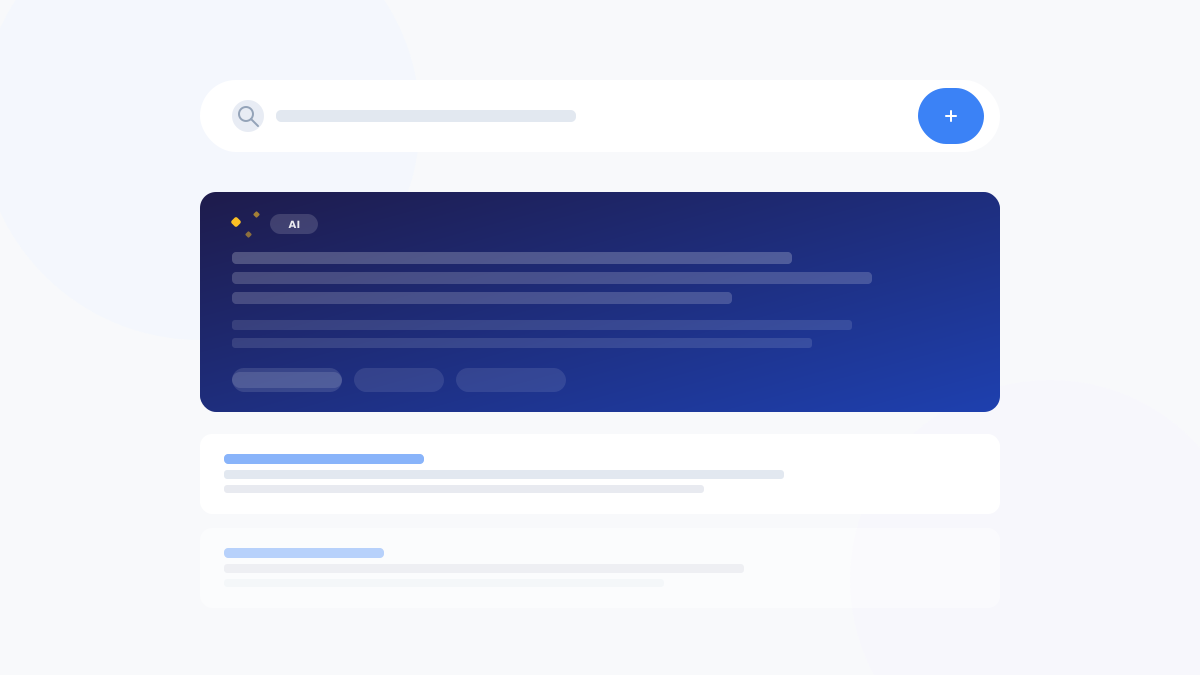
AI-powered search tools are changing how people find information online. Instead of clicking through ten blue links, more users are getting direct answers from AI summaries and assistants. This does not mean your website is irrelevant. It means the bar for what counts as useful, credible content has gone up.
What is AI search?
AI search refers to search engines and tools that use artificial intelligence to generate direct answers, summaries and recommendations — rather than simply returning a list of links. Google's AI Overviews, ChatGPT search, Perplexity and similar tools all fall into this category.
When someone asks "what should I look for in a website designer in Malaysia," an AI search tool might pull information from multiple sources and generate a direct answer — without the user needing to click through to individual websites.
This matters because your website may be cited as a source, bypassed entirely, or used as evidence for or against your credibility — depending on how well its content is structured and how clearly it communicates expertise.
Why search results are becoming more answer-focused
Search behaviour has always trended toward convenience. People want answers, not just links. AI tools accelerate this by doing more of the reading and summarising on the user's behalf.
For businesses, this means that websites which only describe what they do — without explaining why, how or for whom — are increasingly easy to ignore. AI tools favour content that is specific, structured and directly useful.
The Shift
Search is becoming more like a question-and-answer exchange. Businesses whose websites clearly answer the questions their customers are asking will be better positioned than those with vague or generic content.
Why clear website content matters more now
In the past, SEO could be gamed with keyword density and backlink volume. That still partially applies, but AI-powered tools are better at recognising genuine expertise and useful content.
If your website says "we offer comprehensive digital marketing solutions" without explaining what that means, who it is for, and what outcomes you deliver — it is not useful to a human visitor or an AI system trying to summarise the web.
Clear, specific content that answers real questions is now more valuable than ever. This includes your service pages, your about section, your FAQs and any knowledge content you publish.
Why generic AI-generated content is not enough
Many businesses have started using AI tools to generate content quickly. The risk is that AI-generated content, without human strategy and editing, tends to sound like every other AI-generated article on the same topic.
Search engines are getting better at identifying thin or generic content. More importantly, human readers can feel when content lacks real perspective or genuine experience. Content that reads like it was written by a machine for a machine will not build the trust that leads to enquiries.
AI is a useful writing tool. It is not a substitute for understanding your audience, your market and your own positioning.
How businesses can prepare their websites
The businesses best positioned for AI search are the ones that already have clear, well-structured, genuinely helpful websites. Here is what that looks like in practice:
- Write clearer service pages — explain what you do, who it is for, and what the client gets
- Answer real customer questions — think about what your clients ask before hiring you, and answer those questions on your site
- Use useful headings — structure content so it is easy to scan and understand quickly
- Avoid vague generic copy — "we deliver results" means nothing; specific outcomes do
- Include location and service context — "website design for Malaysian SMEs" is more useful than "website design"
- Keep content human and helpful — write for people first, algorithms second
- Build a knowledge hub over time — consistent, useful content signals authority to both humans and search engines
Service pages still matter
Some businesses assume that with AI search, individual service pages matter less. The opposite is true. A well-written website design or SEO service page that clearly explains your offer, process and outcomes is exactly the kind of content AI tools draw from when answering questions about vendors and providers.
If your service page is a single paragraph with a contact form, it is not serving you well in any search environment.
Trust and authority still matter
AI search tools — like human visitors — favour sources that appear credible. This means your website needs to demonstrate who you are, what you have done and why you can be trusted. A portfolio, client testimonials, a clear about section and a consistent publishing history all contribute to this.
Businesses with thin online footprints — no real about page, no portfolio, no published knowledge content — are harder for both humans and AI to trust.
"SEO is not dead. Weak content is. The standard for what counts as genuinely useful has simply gone up."
Ringkasan Bahasa Melayu
Google dah berubah. Sekarang, bila orang cari sesuatu, AI kadang-kadang terus bagi jawapan tanpa perlu klik mana-mana website.
Ini bermakna strategi lama — sekadar ada website dengan keyword banyak-banyak — dah tak cukup. Yang penting sekarang ialah kandungan yang betul-betul membantu orang, bukan sekadar ada dalam search result.
Kalau website anda ada maklumat yang spesifik, berguna dan boleh dipercayai, ia masih boleh dapat tempat dalam carian AI. Tapi kalau kandungan generik, memang susah nak bersaing.
Industry Note
Research from Google Search Central's Helpful Content guidance states that content should be written primarily for people, not to rank — and that content written purely to gain search visibility may be demoted algorithmically. The clearest signal Google rewards is demonstrable expertise and genuine usefulness to the reader, not keyword density or article length.
MuckaMedia Take
SEO is not dead. Weak content is. As search becomes more AI-assisted, businesses need websites that are easier to understand, easier to trust and more useful — to both humans and the systems that help people find them.
The good news is that building a clear, well-structured, genuinely helpful website also happens to be the best investment for long-term online visibility. The two goals are the same.
Need help making your website clearer for search and customers?
MuckaMedia helps brands plan SEO-friendly websites and content structures that support long-term visibility — for humans and AI search alike.
Talk to MuckaMedia →